
Robust
Telegram Splitting distributes transmission risk instead of placing it in one packet.
mioty is a standardized LPWAN radio protocol for small sensor data over long distances. Its technical core is Telegram Splitting: a message does not travel as one long block, but as many short radio fragments distributed over time and frequency.
Actual performance depends on device, transmission profile, antennas, environment and network planning.
The endpoint divides its data telegram into small sub-packets. They are transmitted at different times and frequencies. The base station collects the fragments and reassembles the message.
According to the mioty Alliance, forward error correction lets the receiver reconstruct the complete information from 50% of the radio bursts.
mioty is a software-based Low Power Wide Area Network. Its TS-UNB radio layer is standardized in ETSI TS 103 357. Short airtime and sub-packets distributed over frequency and time reduce the risk of one collision destroying the full message.
Telegram Splitting distributes transmission risk instead of placing it in one packet.
The technology is designed for very large numbers of endpoints and messages in one radio cell.
Short radio bursts and long sleep periods support battery-powered sensing.
Networks can use owned infrastructure or be delivered as a managed service.
Captures level, pressure, temperature or a 4–20 mA value.
Splits the message and sends short fragments across time and frequency.
Scans the spectrum, collects fragments and reconstructs the telegram.
Manages devices and passes values to dashboards, alerts or APIs.
Both technologies carry small data volumes efficiently across long distances. They use different radio methods and ecosystems; a sound choice considers site, density, existing infrastructure and integration needs.
| Criterion | mioty® | LoRaWAN® |
|---|---|---|
| Radio principle | TS-UNB with Telegram Splitting | LoRa modulation with LoRaWAN protocol |
| Particular strength | Robustness in dense, interfered networks | Broad ecosystem and flexible network models |
| Infrastructure | Base station and service centre | Gateway and network server |
| Network operation | Private or managed | Private, public or hybrid |
| Typical profile | Very many short sensor messages | Distributed sensing with broad device choice |
The radio brand alone does not decide: interval, packet size, device count, terrain and the existing platform must be planned together.
Many meters send small readings at predictable intervals.
Distributed legacy points join monitoring without a new data cable.
Parking, environment, waste and infrastructure create many short messages.
Plant rooms and deep indoor points benefit from robust radio planning.
Short radio bursts also support moving endpoints in suitable application profiles.
Widely distributed sensors report conditions, levels or climate across large areas.
mioty is built for small, periodic or event-driven data packets. Video, audio, large firmware files, continuous streaming and hard real-time control loops do not belong on an LPWAN. Range and battery life are also planning values—not guarantees without a radio and load profile.
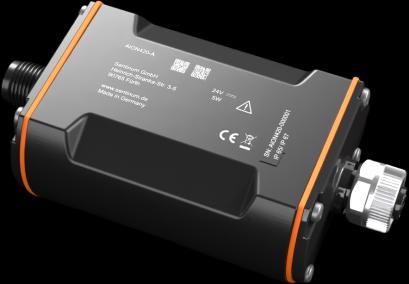
AION420 reads two existing 4–20 mA signals and transmits the readings wirelessly. Depending on the variant, LoRaWAN or mioty is available as the radio path. The analogue sensing stays in place while its data reaches the network server and application.